Why Review Velocity Matters More Than Review Volume
Learn how consistent, recent reviews boost trust and local SEO rankings
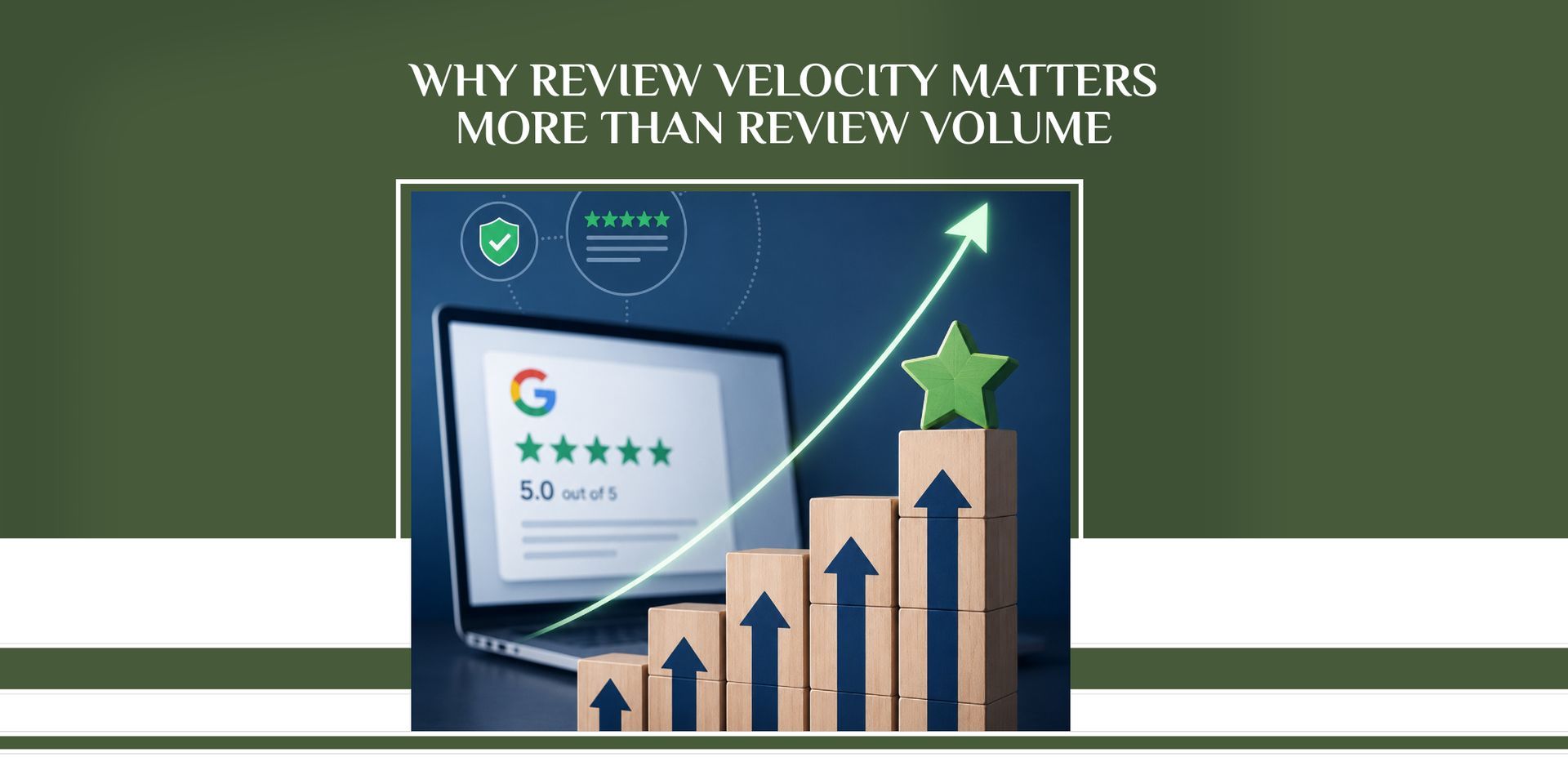
Most UK service businesses focus on how many reviews they have. The number sitting next to their star rating feels like the obvious measure of success. But there is a more important question that both Google and your potential customers are quietly asking: when did those reviews arrive, and are they still coming in?
Review velocity is the rate at which your business collects new reviews over time. It is not about the total count on your profile. It is about consistency, recency, and the steady signal those reviews send to search engines and real people alike. For any UK service business serious about reputation management, understanding review velocity is where a smarter approach begins.
What Is Review Velocity and Why Should You Care?
Review velocity is a straightforward concept: it measures how frequently a business receives new reviews, rather than how many it has accumulated in total. A business with 200 reviews collected over five years and a business with 40 reviews collected steadily over the past 12 months are telling very different stories to Google and to the people searching for their services.
Search engines, and Google in particular, treat review recency as a trust signal. A profile that regularly receives fresh feedback looks like an active, well-used business. A profile where all the reviews are dated two or three years ago looks dormant, regardless of the star rating. Potential customers notice this too, even if they do not consciously think about it. When someone scans a Google Business Profile and sees that the most recent review was posted 18 months ago, a small but real doubt enters their mind.
For UK service businesses, whether you are a double glazing installer, a removal company, a cleaning firm, or a care provider, your Google Business Profile is often the first impression a local customer sees. The velocity of your reviews shapes that impression just as much as the rating itself.
The Problem with One-Off Review Campaigns
Many businesses try to boost their online reputation through a single push. They email their entire customer list, ask their team to remind clients, and spend a couple of weeks actively chasing feedback.
The result is a cluster of 20, 30, or even 50 reviews arriving in a short window. It feels like a win. The problem is what happens next, and what those platforms make of it.
Why a Sudden Spike in Reviews Can Backfire
Google's review systems are built to detect patterns that look unnatural. A sudden influx of reviews arriving within days or weeks of each other can trigger the platform's filtering mechanisms, meaning some of those hard-earned reviews may not be displayed at all.
This is not a penalty in the traditional sense, but it is a frustrating outcome for a business that put genuine effort into asking real customers for honest feedback.
Beyond the algorithmic concern, real customers notice clustering too. When someone reads through a Google Business Profile and sees that 35 of the 40 reviews were posted in the same three-week window, it raises questions.
Even if every single one of those reviews is completely genuine, the pattern does not feel organic. Scepticism is a reasonable human response, and it can quietly undermine the trust you were trying to build.

What Happens to Your Reputation After the Burst Fades?
A business that collects 30 reviews in one month and then goes six months without a single new one is sending a clear signal: activity has stalled. For prospective customers comparing two similar businesses, that quiet period matters.
Your competitor who has been collecting two or three reviews every month looks like the busier, more established, more trusted option, even if their total count is lower than yours.
This is the trust gap that review velocity is designed to close. Consistency tells a story of a business that is actively serving customers and regularly earning their feedback. A one-off burst followed by silence tells a very different story.
How Consistent Reviews Build Long-Term Trust
Steady review collection creates a compounding effect that a single campaign simply cannot replicate. Each new review adds a fresh data point to your profile, one that confirms to Google and to potential customers that your business is open, active, and delivering for real people right now.
Think about it from a customer's perspective. They are searching for a local service provider, and they land on two profiles with similar star ratings. One has reviews from the past few weeks. The other has nothing newer than eight months ago. The profile with recent activity feels safer. It feels current.
That feeling directly influences the decision to call or click.
Consistent feedback also reinforces credibility with search algorithms over time. Google's local ranking systems weigh the freshness of your reviews as part of a broader picture of relevance and trustworthiness.
A business that maintains a steady flow of genuine feedback is continuously refreshing that signal, rather than relying on a snapshot that gets older every day.
This is the foundation of building unshakeable customer trust. It is not built in a sprint. It is built through consistent, honest feedback collected over months and years.
Does Review Velocity Actually Affect Your Google Rankings?
Yes, and the evidence points in one clear direction. Google's local search ranking factors include the recency of reviews as a meaningful signal. A business that regularly collects new feedback is seen as more relevant and more active than one whose profile has gone quiet, even if the quieter profile has a higher overall review count.
A 2023 study by Whitespark, one of the most cited sources on local SEO ranking factors, confirmed that review signals, including quantity, recency, and the pace of new reviews, continue to carry significant weight in Google's local pack results.
Recency, in particular, is something that no amount of historical reviews can compensate for. Yesterday's reviews do not speak to what your business is doing today.
For UK service businesses competing in local search, this matters enormously. Local SEO is intensely competitive in most towns and cities, and the businesses that show up in the Google local pack are typically those that demonstrate ongoing relevance.
A steady flow of recent reviews is one of the clearest signals of that relevance. If you want a deeper look at the relationship between your Google profile and search performance, read more about whether do Google reviews boost SEO rankings.
What Does a Healthy Review Velocity Look Like for a UK Service Business?
There is no single number that works for every business. Review velocity is relative to your industry, your customer volume, and how active your competitors are locally. What matters most is consistency, not hitting an arbitrary target.
Setting Realistic Review Targets by Business Type
A local sole-trader tradesperson, such as an electrician or decorator, might realistically aim for two to four new reviews per month.
A busy removal company, dental practice, or cleaning firm serving multiple customers per week could reasonably target six to ten. A larger operation with high daily footfall might aim even higher.
The practical starting point is to look at your closest competitors in local search and understand roughly how frequently they are collecting reviews.
You do not need to match them immediately. You just need to build a process that keeps your profile moving forward at a consistent pace.
A business collecting three genuine reviews every month will, over the course of a year, build a far more compelling profile than one that collected 30 in January and nothing since.

How Automated Review Collection Keeps the Momentum Going
The most common reason UK service businesses lose review velocity is not that their customers are unwilling to leave feedback. It is that asking gets forgotten.
After a job is done, the focus moves to the next customer. Staff change. Processes slip. Months pass without a single new review arriving.
Automation solves this quietly and reliably. When a review request is sent automatically at the right point in the customer journey, every completed job becomes an opportunity for feedback, without anyone having to remember to ask.
The request goes out consistently, the timing is right, and the process does not depend on any single person's memory or confidence.
At Customer Feedback Centre, our approach is built around exactly this: ethical, automated review collection that keeps the momentum going without adding to your workload.
If you want a practical guide to putting this in place, take a look at how to get more customer reviews.
The Competitive Edge of Staying Active in Reviews
Here is a scenario that plays out across the UK every single day. A homeowner needs a plumber.
They search on Google, and two results appear side by side. The first plumber has 80 reviews and a 4.7-star rating.
The last review was posted 14 months ago. The second plumber has 30 reviews and a 4.8-star rating. The last review was posted two weeks ago.
Most people will call the second plumber.
Not because 30 is better than 80, but because recent activity signals current relevance. It says: this business is busy, people are still using them, and they are still delivering.
The older profile, despite its impressive total, feels like it belongs to a business that may have changed, slowed down, or stopped caring about its reputation.
This is the competitive edge that review velocity creates. It does not require you to have the most reviews in your category. It requires you to be the most consistently active.
Understanding why your business reputation actually matters is the first step to protecting it with the right habits.
Common Reasons UK Service Businesses Lose Review Momentum
Review velocity rarely collapses all at once. It tends to fade gradually, and the reasons are almost always practical rather than intentional.
Forgetting to ask is the most common cause. Without a system, review requests depend entirely on individuals remembering to bring it up at the right moment.
That is an unreliable process. Relying on a single touchpoint, such as a follow-up email that only goes to certain customers, means a large portion of your satisfied clients never hear from you at all.
Staff turnover can disrupt whatever informal process was in place, and seasonal dips in customer volume naturally reduce the flow of incoming feedback.
The good news is that every one of these barriers is solvable. None of them require significant resources or complex changes to how you run your business.
They require a reliable system that works in the background, consistently, regardless of who is on your team or how busy the month has been.
If your reviews have stalled, the guide on why your Google reviews are stuck is a practical place to start.
How to Maintain Review Velocity Without Overwhelming Your Customers
Consistent review collection does not mean bombarding customers with requests.
The goal is to make asking for a review feel like a natural part of how you close out a job or service, not an awkward add-on that customers feel pressured by.
The most effective approach is to integrate review requests into your existing post-service process.
After a job is complete, a simple, well-timed message that thanks the customer and invites them to share their experience takes seconds to read and feels genuine rather than pushy.
The timing matters, ideally within 24 to 48 hours while the experience is still fresh.
The tone matters too; a request that feels human and straightforward gets a far better response than a template-heavy ask that screams automation.
One principle is worth stating clearly: ask every customer, not just the ones you are confident will leave five stars.
Cherry-picking who you ask is not only ethically questionable, it also creates a distorted profile that does not reflect your actual service. The most trustworthy review profiles include a range of experiences, handled honestly.
For a more in-depth guide on doing this right, read about how to stop chasing reviews and start getting them naturally.
Frequently Asked Questions
What is review velocity and why does it matter for my business?
Review velocity is the rate at which your business collects new reviews over time. It matters because search engines like Google use the recency and frequency of reviews as a signal of how active and relevant your business is. A business with a steady, consistent flow of new reviews appears more trustworthy to both algorithms and potential customers than one with a large number of older reviews and no recent activity.
How many reviews should a UK service business aim to collect each month?
There is no fixed number that applies to every business. A sole-trader tradesperson might aim for two to four reviews per month, while a busier business serving more customers per week might target six to ten or more. The most important thing is consistency. Collecting a small number of reviews every month is far more valuable, in terms of both SEO and customer trust, than collecting a large number in one go and then going quiet.
Can too many reviews in a short space of time look suspicious to Google?
Yes, it can. Google's review systems are designed to identify patterns that look unnatural. A sudden cluster of reviews arriving in a very short window may trigger filtering, meaning some reviews might not be shown. Even when the reviews are completely genuine, the pattern can look suspicious to customers reading your profile. Spreading review collection out over time is a safer and more effective approach.
Does the date of a review affect how much customers trust it?
Absolutely. Research consistently shows that customers pay close attention to how recent reviews are. A significant portion of people consider reviews older than three months to be less relevant when making a decision. An older review, even a glowing one, does not tell a potential customer anything about the quality of your service today. Recent reviews carry far more weight in the decision-making process.
How does review velocity compare to overall review volume in terms of SEO impact?
Both matter, but they work differently. A high total review count contributes to your overall authority and credibility on Google. Review velocity, meaning how recently and frequently those reviews are being added, affects how Google perceives your current relevance. In local SEO, a business with fewer but more recent reviews will often rank above a competitor with more total reviews that have gone stale. The ideal profile combines a solid total count with a consistent, ongoing flow of fresh feedback.
What is the best way to keep collecting reviews consistently without annoying customers?
The key is to make review requests a natural part of your post-service process rather than a separate campaign. A simple, well-timed message sent within 24 to 48 hours of a completed job, written in a genuine and human tone, is far more effective and far less intrusive than a mass email blast. Automation helps here, because it ensures every customer receives a request at the right moment without relying on anyone remembering to ask.
Will older reviews hurt my business even if I have a high overall star rating?
Older reviews will not actively harm your reputation, but they will stop helping it as much as they once did. If your most recent reviews are many months or years old, potential customers may question whether your business is still operating at the same standard. In competitive local search results, a business with a slightly lower overall rating but far more recent reviews will often be chosen over one with a better rating but stale feedback. Maintaining a steady flow of current reviews is how you keep your profile working actively in your favour.
Customer Feedback Centre helps UK service businesses build steady, ethical review momentum through simple, automated tools designed to keep feedback flowing consistently, not in bursts.
Discover what the Customer Feedback Centre could do for your business.
No contract required. Cancel anytime. Setup in as little as 24 hours.
Prefer to ask a question first? Use the contact form on our Contact page and we'll get back to you promptly.
Recent Posts