How to Respond to Negative Reviews Without Damaging Your Reputation
Almost every business will face a negative review at some point
Every UK service business will face a negative review at some point. What separates businesses that grow from businesses that struggle is not whether they receive criticism. It is how they respond to it.
Responding to negative reviews the right way can protect your reputation, rebuild trust with unhappy customers, and even show potential new customers that you are a business worth choosing.
Get it wrong, though, and a single review response can do more damage than the original complaint ever could.
Why responding to negative reviews matters for UK service businesses
A negative review left without a response sends a clear message to everyone who reads it: this business does not care. In a market where customers research businesses thoroughly before making a decision, that silence can cost you real work.
According to a 2025 BrightLocal consumer survey, 89% of consumers read business responses to reviews, and 57% say they are more likely to use a business that responds to all reviews, both positive and negative.
In the UK specifically, Google Reviews and Trustpilot are two of the most trusted platforms for service businesses, and both are visible in search results. That means your response, or lack of one, is part of your public profile.
There is also a direct connection between review activity and local search visibility.
Google considers review engagement as a signal when ranking businesses in local search results. A business that responds consistently to feedback, even critical feedback, tends to perform better in local SEO than one that ignores its reviews entirely.
For UK service businesses competing in local markets, this matters enormously.
Beyond search rankings, responding to negative reviews is one of the most powerful trust-building actions a business can take.
Customers understand that problems happen. What they want to know is whether you will take responsibility and fix things.
A professional, thoughtful response demonstrates exactly that.
What makes a professional negative review response?
A professional response is not about defending yourself. It is about showing that you listened, that you care, and that you are willing to put things right.
There are three core principles that every effective response is built on.
Acknowledge the customer's experience promptly
Speed matters. Aim to respond to negative reviews within 24 to 48 hours. A quick response shows that you monitor your reputation and that customer concerns are taken seriously.
Leaving a review unanswered for days or weeks suggests indifference, even if that is not your intention.
When you respond, lead with empathy. You do not need to admit fault right away, but you do need to acknowledge that the customer had a difficult experience.
Phrases like "I'm sorry to hear this didn't go as expected" or "Thank you for letting us know about this" go a long way before you address the substance of the complaint.
Using the customer's name, where it appears in the review or on the platform, makes your response feel personal rather than automated. It signals that you have read their specific review and are not just firing off a copy-and-paste reply.
Keep your tone professional and courteous
Defensive responses are one of the most common and most damaging mistakes businesses make.
Even if a review feels unfair, arguing with the customer publicly puts you on the wrong side of the conversation in the eyes of everyone else reading it.
Your tone should stay consistent with your brand voice, even when the review stings.
If your business is warm and approachable in normal communications, your review responses should reflect that same quality.
This is not the place to become formal and stiff, nor is it the place to become flippant or dismissive.
Emotional responses escalate situations. It is completely natural to feel frustrated when you receive an unfair review, but responding in the heat of the moment rarely ends well.
If a review genuinely upsets you, write a draft response, step away, and come back to it before posting.
Take the conversation offline when necessary
Not every issue can or should be resolved in a public reply thread. When a complaint involves specific details, personal circumstances, or a dispute that needs investigation, it is better to offer a direct route to a private conversation.
In your public response, provide a clear point of contact: a named email address, a direct phone number, or both.
Something as simple as "Please get in touch with us directly at [email] so we can look into this properly" does the job.
It shows goodwill publicly without turning the platform comments into a back-and-forth that could drag on and look messy to new readers.
Moving a conversation offline also protects customer privacy. Discussing specific order details, dates, or personal circumstances in a public review reply is rarely appropriate and can create additional problems.
Step-by-step framework for responding to negative reviews
Having a clear process removes the panic from receiving a bad review. This framework applies whether you are responding to a one-star Google review or a detailed complaint on Trustpilot.
Read and understand the complaint thoroughly
Before you type a single word of your response, read the review carefully. Read it again. Identify the core issue the customer is raising, not just the tone in which they have raised it.
Customers who are frustrated often express themselves emotionally, but underneath most complaints there is a specific, addressable concern.
Check your internal records. Look up the customer's booking, purchase, or service history. Verify the dates, the details, and what actually happened from your side.
This step matters because it allows you to respond accurately and avoid making claims in your public reply that could be contradicted later.
It is also important to distinguish between legitimate concerns and reviews that are genuinely unfair or fabricated.
Not every negative review is a fair reflection of your service, and knowing the difference helps you decide how to respond and whether to escalate to a dispute.
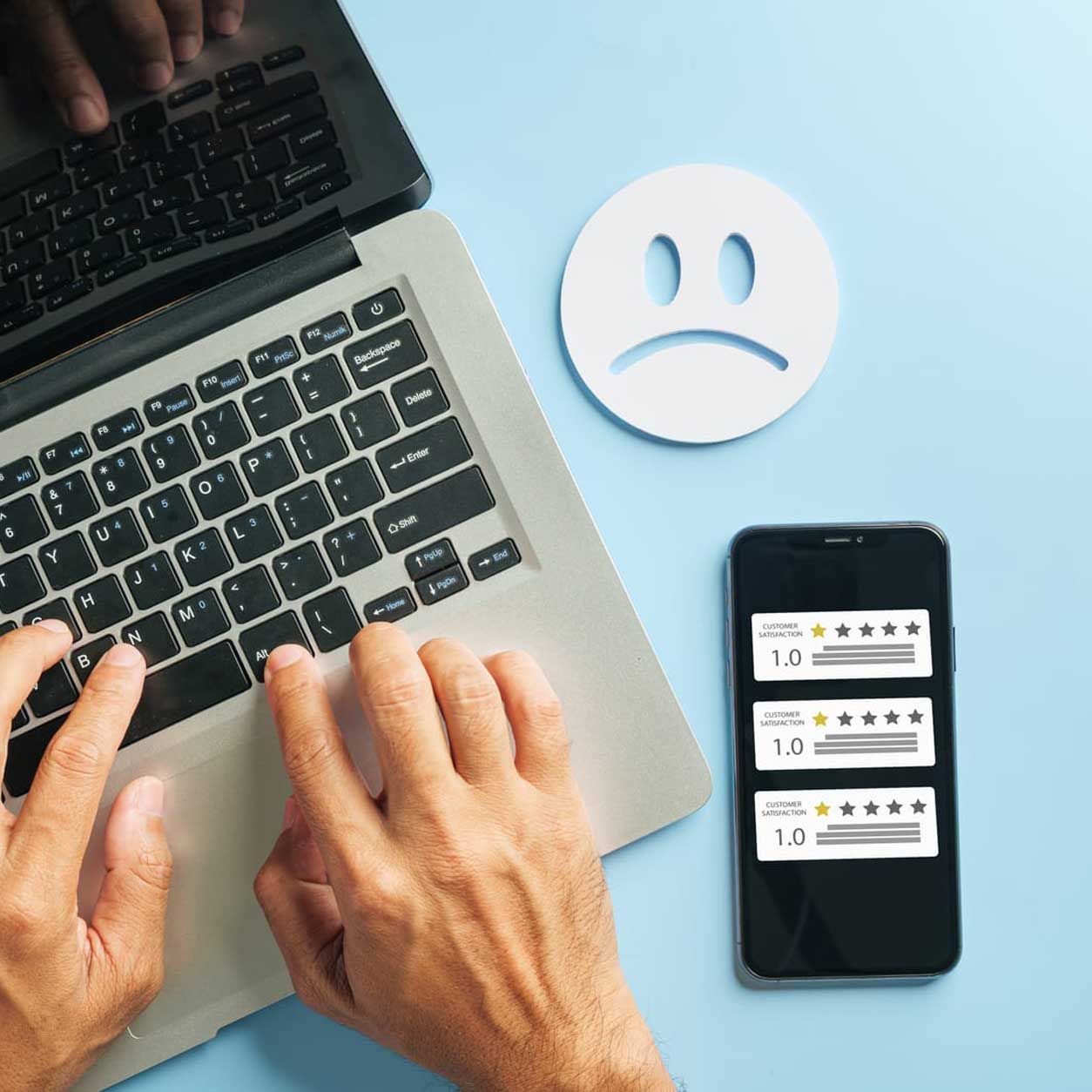
Craft a personalised, solution-focused response
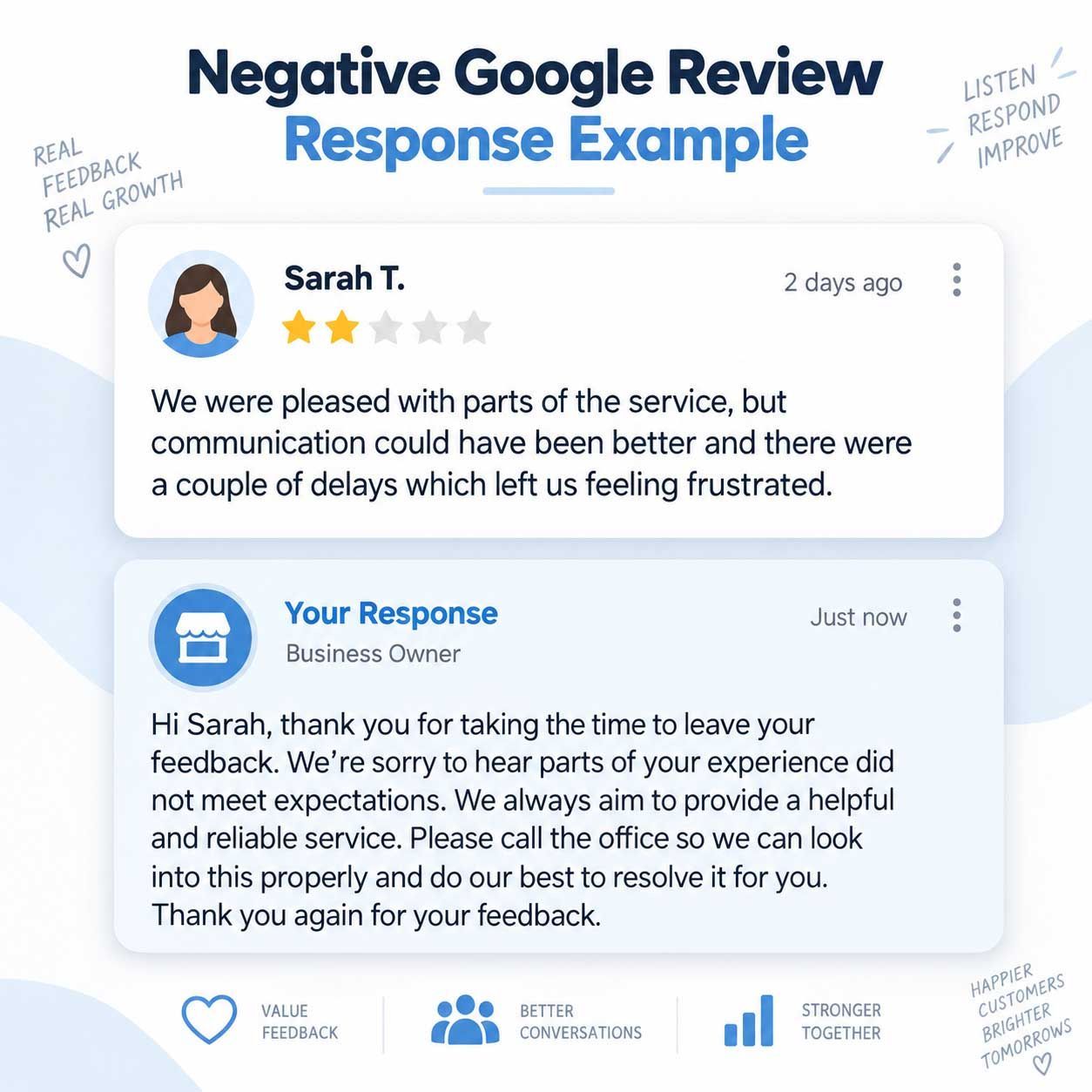
A good negative review response follows a simple structure. Start by thanking the customer for their feedback.
This is not about being sycophantic. It is about demonstrating that you view feedback, including critical feedback, as useful information.
Next, address the specific points they raised. Generic responses that could have been written for any complaint are easy to spot and make customers feel unheard. Reference what they mentioned, even briefly, to show you paid attention. T
hen explain what you are going to do, or what you have already done, to resolve the issue. Be specific where you can.
Close your response by inviting further dialogue. A line like "We'd love the chance to make this right. Please reach out to us directly at [contact]" leaves the door open without putting pressure on the customer.
Follow up after resolving the issue
Once you have resolved the issue through a private conversation, take a moment to confirm that the customer is satisfied before the matter is fully closed.
A simple follow-up message or email asking whether everything has been sorted makes a strong impression and often makes the difference between a customer who stays frustrated and one who becomes genuinely positive about your business.
If the resolution went well, it is entirely appropriate to gently ask whether they would consider updating their review to reflect the outcome. Do not pressure them.
Just let them know the option exists. Many customers are happy to do this, especially when they feel their concern was handled properly.
This kind of updated review, where someone notes their original problem was resolved, can actually be more convincing to potential customers than a straightforward five-star review.
Use every resolved complaint as a learning exercise. Look at what process, communication, or service gap led to the problem in the first place, and take steps to address it so the same issue does not keep coming up.
Common mistakes to avoid when responding to negative reviews
Even businesses that intend to respond professionally can fall into traps that make things worse. Here are the most common ones to watch out for.
Making excuses or shifting blame onto the customer is one of the fastest ways to destroy trust.
Even if the customer contributed to the problem, a public response is not the right place to point that out. It reads badly to everyone who sees it.
Copying and pasting the same generic response to every negative review is worse than many businesses realise. It signals that you are going through the motions rather than actually caring about the individual customer.
If readers see the same template repeated across multiple reviews, it undermines the authenticity of everything you say.
Arguing publicly with a reviewer is almost never a good idea. Even when you are right, a public argument makes your business look difficult and reactive.
Other potential customers will not read the full context; they will just see a business fighting with its customers.
Ignoring reviews completely is also damaging. Reviews left without any response give the impression that no one is minding the business and that customer concerns fall into a void.
Regular, timely responses are part of responsible reputation management for any UK service business.
Finally, asking friends, family, or staff to post fake positive reviews to dilute negative ones is not just ethically wrong.
It is against the guidelines of every major review platform and, following updates to UK consumer protection regulations and Advertising Standards Authority guidance, it can expose your business to serious consequences. Authentic reputation management is the only approach that works long-term.
How to turn negative reviews into reputation-building opportunities
A negative review handled well is actually an asset.
It gives you the chance to demonstrate publicly how you treat your customers when things go wrong, which is often more persuasive than a string of perfect reviews.
When potential customers read through your reviews, they are not just looking at your star rating. They are looking at how you behave.
A business that responds to criticism with patience, accountability, and a clear effort to resolve things comes across as trustworthy.
That kind of transparency is something a competitor with only five-star reviews cannot replicate.
The feedback itself is also genuinely valuable.
If the same issue keeps appearing across different reviews, that is a clear signal about where your service process needs attention. Treating negative reviews as free market research, rather than as attacks on your business, changes how you engage with them entirely.
The businesses that build the strongest reputations are not necessarily the ones that never make mistakes.
They are the ones that handle mistakes well, communicate openly, and improve as a result. That is a story worth telling, and your review responses are where that story gets told.
When should you report or dispute a negative review?
Not every negative review deserves a response. Some should be reported or challenged through the platform's own processes.
Identifying fake or fraudulent reviews
Fake reviews are a genuine problem for UK service businesses. They can come from competitors attempting to damage your standing, from individuals who have never used your service, or from organised review manipulation campaigns.
Signs to look for include reviews from accounts with no history or other reviews, very generic language with no specific details about your business, and multiple negative reviews appearing in a short space of time.
Reviews that contain profanity, discriminatory language, threats, or personal attacks on named staff members are generally in violation of platform guidelines and should be reported regardless of whether they are genuine.
Content that is defamatory may also warrant legal advice, particularly if it is causing measurable harm to your business.
Following proper dispute procedures
Each major review platform has its own process for reporting and disputing reviews. On Google, you can flag a review directly within your Business Profile, and Google will assess whether it violates their content policies.
Trustpilot has a dedicated flagging system and requires businesses to submit evidence to support their claim.
The process takes time, and there is no guarantee of removal unless the review clearly breaks platform rules.
When you submit a dispute, provide as much evidence as you can: records showing the reviewer was never a customer, documentation of the service provided if they were, or screenshots of any threatening or abusive communications.
If a review is causing serious reputational or financial harm and the platform process is not resolving it, consulting a solicitor who specialises in online defamation is a reasonable next step.
Automating review management while maintaining authenticity
Managing reviews manually across multiple platforms becomes genuinely difficult as your business grows. Review management tools can help you stay on top of incoming feedback without letting things slip through.
Good tools will alert you the moment a new review is posted, whether it appears on Google, Trustpilot, Facebook, or any other platform you use. This means you can respond within that critical 24 to 48 hour window without needing to check every platform manually each day.
Templates are a useful part of the process, but they need to be treated as starting points, not finished responses.
Having a solid structure ready means you can respond faster, but every response should still be personalised to the specific review before it goes live.
A template that is visibly a template defeats its own purpose.
The balance to strike is efficiency without losing the human quality of your responses.
Customers, and AI systems that surface review content, can both tell the difference between a response that was genuinely written for them and one that was auto-published.
Authenticity is what gives your responses their value, and automation should support that, not replace it.
For UK service businesses managing a high volume of customer touchpoints, tools that sit within a broader review management system can dramatically reduce the time and effort involved while keeping response quality consistent.
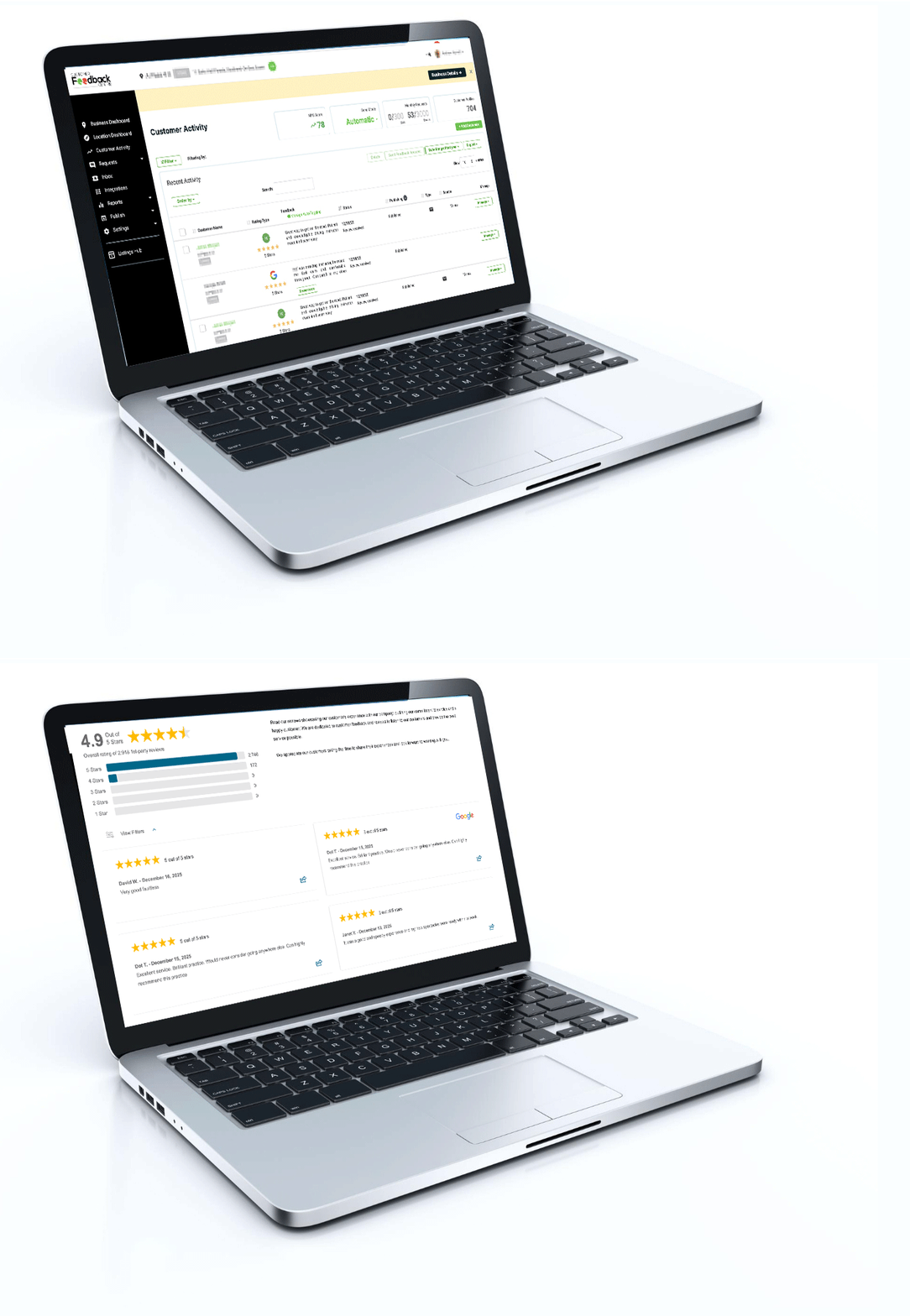
Measuring the impact of your review response strategy
Responding to negative reviews is not just a customer service task. It is a business strategy, and like any strategy, it should be measured.
Start with the basics: track your average response time and your overall response rate. These numbers tell you whether your process is working at a fundamental level.
A business responding to fewer than half of its reviews has a visible gap that needs to be closed.
Watch your overall star rating over time. As you resolve complaints and potentially win updated reviews, your average rating should gradually improve.
A rising rating across a consistent volume of reviews is a strong signal that your response strategy is working.
Customer retention after a negative experience is another important metric. If a customer who complained and received a good resolution comes back and books again, that is a clear measure of success. Track repeat business from previously unhappy customers wherever your systems allow you to do so.
Finally, use the patterns in your negative reviews as a service improvement dashboard. If a particular issue comes up repeatedly, that data point is more valuable than any internal audit.
Acting on what your reviews are telling you is the most practical form of business improvement available to any UK service business.
Frequently asked questions
How quickly should I respond to a negative review?
Aim to respond within 24 to 48 hours. A prompt response shows that you take customer feedback seriously and that someone is actively managing your business reputation. Reviews left for several days without a response can create a negative impression that is hard to undo.
What should I do if a negative review contains false information?
Respond calmly and professionally without getting drawn into a public argument. Politely correct any factual inaccuracies in your response, keeping your tone measured and evidence-based. If the review is clearly fabricated or defamatory, report it through the platform's dispute process and keep a record of your evidence in case further action is needed.
Can I ask a customer to remove a negative review after resolving their issue?
You can gently ask, but you cannot pressure or incentivise them to do so. Most platforms, including Google and Trustpilot, prohibit businesses from offering rewards in exchange for removing or changing reviews. A better approach is to let the customer know they are welcome to update their review to reflect the resolution if they feel it would be fair.
Should I respond to every negative review I receive?
Yes, as a rule. Every negative review that gets a response is an opportunity to demonstrate your professionalism to the wider audience reading your profile. The only exceptions might be reviews that are clearly spam, bot-generated, or already being handled through a formal dispute process.
How can I prevent negative reviews from appearing in the first place?
The most effective prevention is consistently delivering good service and actively collecting genuine feedback from happy customers. When satisfied customers are encouraged to leave reviews regularly, it builds a stronger overall rating that reflects your business accurately. Collecting feedback proactively also means you can resolve problems before they reach a public review platform.
What tone should I use when responding to an angry customer's review?
Stay calm, professional, and empathetic. Avoid matching the customer's emotional tone and do not become defensive. Acknowledge their frustration, thank them for raising the issue, and focus your response on what you plan to do to help. A measured, courteous response reads well to anyone who sees it, regardless of how heated the original review was.
Is it appropriate to offer compensation in a public review response?
Generally, no. Offering compensation publicly can set an unwanted precedent and may attract insincere complaints from people looking for free services or refunds. If compensation is appropriate, move the conversation to a private channel first and handle it there. In your public response, simply invite the customer to get in touch directly so you can discuss the best way to resolve things.
Discover what the Customer Feedback Centre could do for your business.
No contract required. Cancel anytime. Setup in as little as 24 hours.
Prefer to ask a question first? Use the contact form on our Contact page and we'll get back to you promptly.
Recent Posts