How Automated Review Collection Builds Long-Term Trust
Build a stronger online reputation and attract more customers through consistent, credible reviews
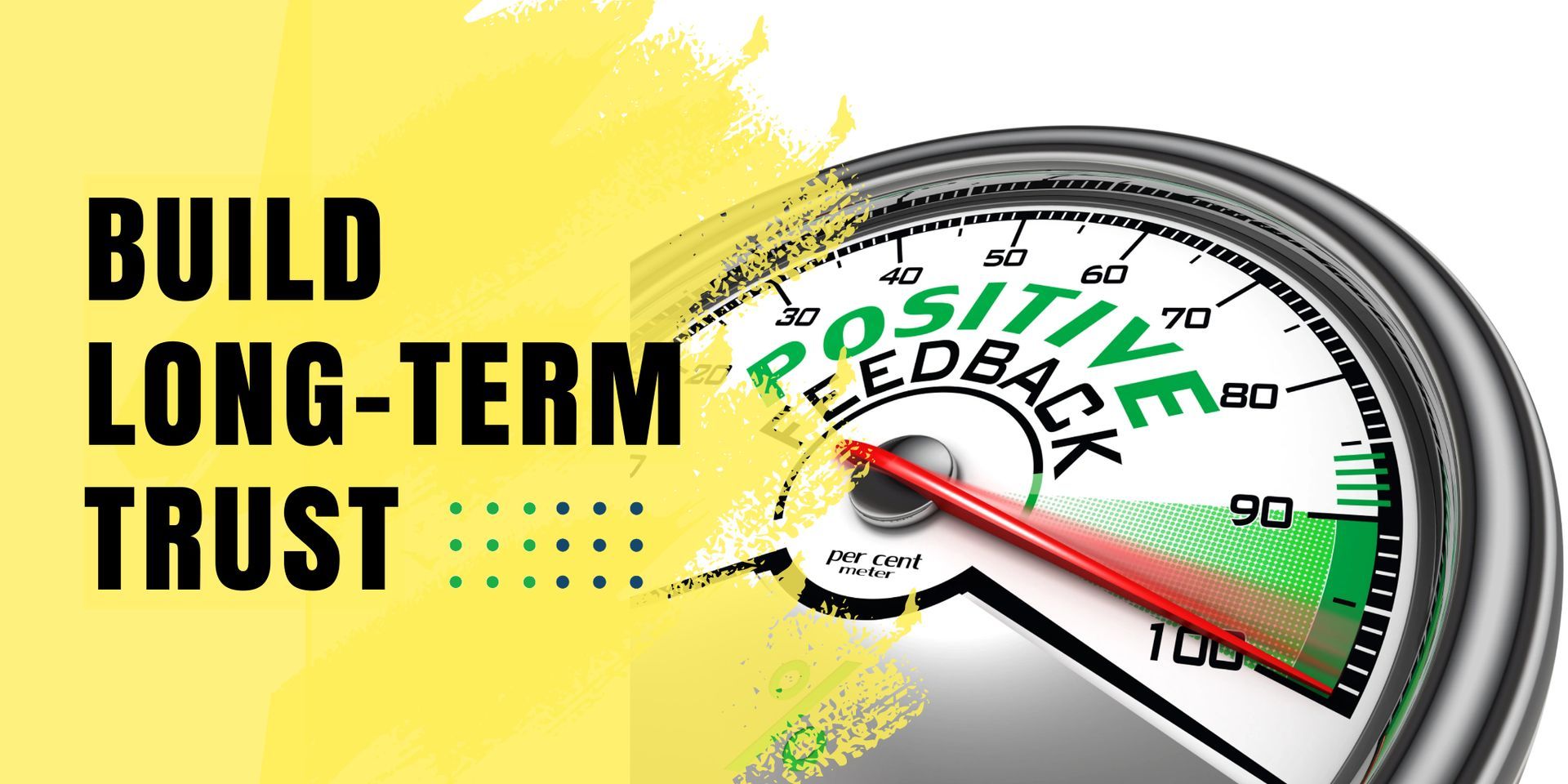
For UK service businesses, trust is everything. Before a potential customer picks up the phone or fills in a contact form, they will almost certainly check your reviews.
What they find in those first few seconds can make or break their decision.
Automated review collection is the process of systematically gathering genuine customer feedback through timed, triggered requests after a service interaction, and it is one of the most effective ways to build a credible, consistent online reputation over time.
This article explains how the process works, why it matters for long-term business growth, and how to do it ethically and effectively.
Why Consistent Review Collection Matters for Service Businesses
Most UK service businesses do collect reviews at some point, but very few do it consistently.
Reviews tend to come in clusters after a particularly good month, then dry up for weeks or even months. To a potential customer browsing your Google profile, that gap speaks volumes.
Consistency signals that a business is active, accountable, and regularly delivering good experiences.
A business with 15 reviews spread across three years tells a different story than one with 15 reviews from the past six months, even if the star ratings are identical.
The latter feels current. The former raises questions.
Social proof works through accumulation.
Each new review adds to a body of evidence that reassures prospective customers they are making a safe choice.
When that accumulation stops, the reassurance weakens.
For service businesses where trust is a core part of the buying decision, such as tradespeople, healthcare providers, legal firms, or financial advisers, that weakness has a direct impact on enquiry levels.

This is precisely why automating review collection is a strategic decision, not just a convenience.
It removes the dependency on individual team members remembering to ask, on busy periods allowing time to follow up, or on customers proactively leaving feedback without a prompt.
It makes consistency a default rather than an exception.
What Is Automated Review Collection?
Automated review collection is the use of software to send review requests to customers at the right moment, through the right channel, without requiring manual effort from the business each time.
In practice, it works like this. When a service interaction is completed, whether that is a booked appointment, a completed job, or a closed customer support ticket, the system detects that trigger and sends a request to the customer asking them to share their experience.
That request is usually delivered by email or SMS, and it includes a direct link to the relevant review platform, most commonly Google.
The timing, message, and channel are all set up in advance.
Once the workflow is configured, it runs automatically in the background. Businesses using Customer Feedback Centre's platform benefit from a streamlined setup that handles this process without adding complexity to their day-to-day operations.
It is worth being clear about what ethical automated review collection is not. It does not involve paying customers to leave reviews, offering discounts in exchange for positive feedback, or sending requests only to customers who are likely to be happy.
Those approaches violate Google's review policies and, more importantly, they undermine the trust that reviews are supposed to build.
How Does It Differ from Manual Review Requests?
Manual review collection relies on a team member remembering to ask, finding the time to follow up, and hoping the customer acts on an informal request.
It is inconsistent by nature, prone to being skipped during busy periods, and heavily dependent on the confidence and initiative of individual staff members.
Automated review collection removes all of those variables.
The request goes out at the same point in every customer journey, with the same clear message and direct link, regardless of how busy the team is or whether anyone remembered to follow up.
The difference in outcomes is significant.
Businesses that switch from manual to automated processes typically see a sharp increase in review volume simply because they are asking every eligible customer, not just the ones they happen to remember or feel comfortable approaching.
For the customer, a well-crafted automated request also feels less awkward than being asked face-to-face and gives them the flexibility to respond in their own time.
The Trust-Building Mechanism Behind Review Automation
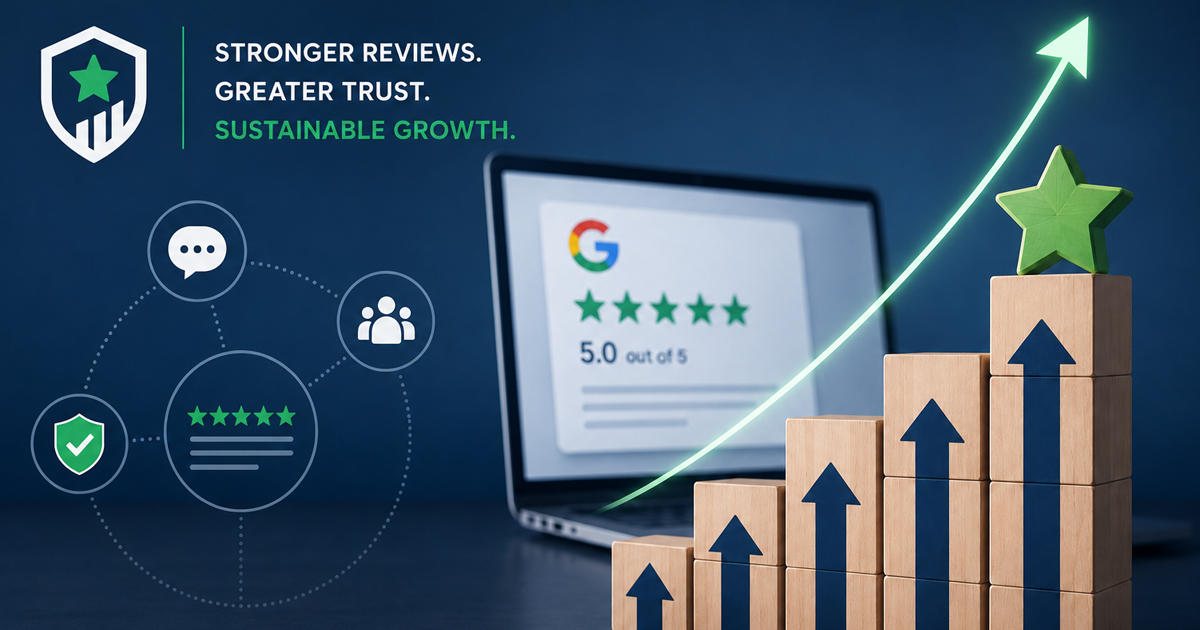
Reviews influence purchasing decisions because they replicate something humans have always relied on: the opinions of other people.
When a potential customer reads that 47 different people had a positive experience with your business, that is far more persuasive than anything you could say about yourself.
But the psychology of social proof is not just about volume. It is about recency and relevance.
According to BrightLocal's 2024 Local Consumer Review Survey, 85% of consumers consider reviews older than three months to be less relevant. A business with 200 reviews but none in the past six months creates doubt, not confidence.
Automation addresses this directly by ensuring reviews arrive regularly rather than in one-off bursts.
There is also a compounding effect at play. A business that collects ten reviews a month will have 120 more reviews by the end of the year than one that collects nothing.
That growing body of evidence builds credibility over time in a way that cannot be replicated by a one-time push for reviews. It is the difference between a campaign and a system.
For service businesses in particular, where customers are often making decisions about who to let into their home or who to trust with sensitive work, that volume of consistent, genuine feedback is one of the most powerful trust signals available.
Why Recency of Reviews Matters to Potential Customers
When someone is researching a business, they almost always sort reviews by most recent first.
If your most recent review is from seven months ago, the immediate question in their mind is: what has happened since then?
Consumers use recency as a proxy for reliability. A business that was great two years ago but has no recent feedback leaves too much uncertainty. Has the quality dropped?
Have the key staff changed? Is the business even still operating at the same standard? Recent reviews answer those questions without the customer having to ask them.
This is why review collection should be treated as an ongoing activity, built into the customer journey permanently, rather than something you do in January as part of a new year push and then forget about.
Automation makes that permanence easy to maintain.

Ethical Automation: What It Means and Why It Matters
Ethical review automation means collecting genuine feedback from real customers through transparent, pressure-free processes that comply fully with Google's review policies and the UK's consumer protection standards.
In simple terms, it means every review request goes to every customer after a completed interaction, the customer is free to share whatever experience they actually had, and nothing is offered in return for a positive review.
The business does not cherry-pick which customers receive a request. The process is the same whether the job went perfectly or whether there was a minor issue that was resolved.
This approach is not just the right thing to do. It is also the smart long-term strategy.
Businesses that manipulate their review profiles, whether through fake reviews, incentivised feedback, or selective sending, are building on an unstable foundation.
Google actively removes reviews it suspects are inauthentic, and businesses caught violating its policies risk having their entire review profile suspended.
Beyond the platform risk, savvy consumers are increasingly good at spotting profiles that look too good to be true.
Customer Feedback Centre's approach is built entirely around ethical automation.
The tools are designed to reflect a business's genuine reputation, whatever that looks like, and to help improve it through real service delivery and real customer voices.
What Makes a Review Collection Process Genuinely Ethical?
A genuinely ethical review collection process has a few clear characteristics.
First, review requests are sent to all customers, not just those the business believes had a positive experience. Selectively sending requests to cherry-picked customers is a form of manipulation, even if no fake reviews are involved.
Second, no incentive is offered in exchange for a review. That includes discounts, free services, entry into competitions, or any other form of reward.
Google's guidelines are explicit on this point, and any review left in exchange for an incentive is in violation of those guidelines.
Third, the process is transparent. Customers know they are being asked to share their experience and are free to say whatever reflects their actual view.
A business that collects reviews ethically is confident enough in its service to invite honest feedback without trying to control the outcome.
This kind of ethical practice protects a business's long-term reputation. A strong review profile built on genuine feedback is an asset. A manipulated one is a liability waiting to be exposed.
How Automated Review Collection Strengthens Your Competitive Position
In local search, reviews are not just a trust signal for customers. They are a ranking signal for Google.
Businesses with a higher volume of recent, genuine reviews consistently appear more prominently in local search results, particularly in the local pack, the three business listings that appear at the top of a Google search for a local service.
A competitor with 200 reviews and a 4.7 average rating is going to appear ahead of you in search results if you have 30 reviews and a 4.5 rating, even if your service is objectively better.
Automated review collection directly addresses this by ensuring your review volume grows steadily and your rating reflects the full range of your customer experiences.
Beyond search rankings, a stronger review profile changes how potential customers perceive you the moment they land on your listing.
More reviews mean more evidence, which reduces the perceived risk of choosing your business.
For service businesses where the buying decision involves a degree of trust, that reduced risk converts directly into more enquiries and more customers.
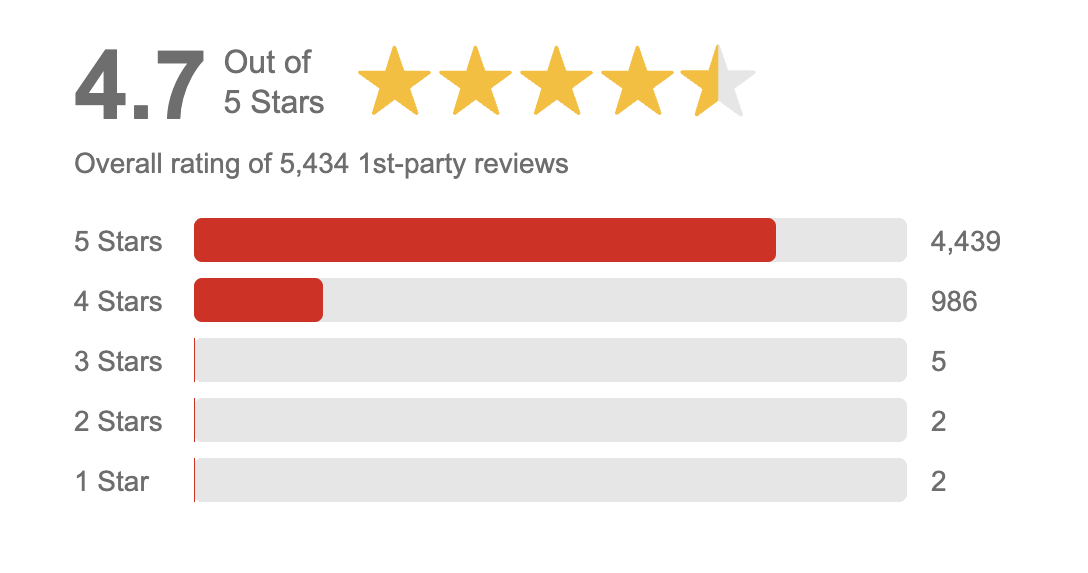
Businesses that treat review collection as a consistent, automated process build a compounding advantage over competitors who treat it as an afterthought.
The gap in review volume between a business with a system and one without grows wider every month.
Does Having More Reviews Actually Improve Local Search Rankings?
Yes. Google has confirmed that review signals are a factor in local search rankings.
According to Google's own guidance on how it ranks local results, prominence, which includes online reviews and ratings, is one of the three core ranking factors alongside relevance and distance.
Research from Whitespark's 2023 Local Search Ranking Factors report placed review signals as one of the top contributors to local pack rankings.
This includes review quantity, review velocity (how frequently new reviews arrive), and average star rating.
A business that collects reviews consistently through an automated system performs better across all three of these signals than one that collects reviews sporadically or not at all.
For UK service businesses that depend on appearing in local search results to attract customers, this is not a minor detail. It is one of the most direct, controllable actions available to improve search visibility.
Practical Steps to Implement an Automated Review Collection System
Getting started with automated review collection does not need to be complicated. The goal is to create a simple workflow that feels natural to the customer and runs reliably in the background.
The first step is identifying the right trigger point in your customer journey. This is the moment after which a review request makes sense, typically when the service has been completed and the customer has had enough time to form a view.
For a plumber, that might be the afternoon after a job is done. For a solicitor, it might be once a matter has been formally closed.
The second step is choosing your delivery channel. Email works well for businesses where email communication is already part of the customer relationship. SMS tends to achieve higher open rates and is often better suited to trade services or mobile-first customers.
Many businesses use both, sending an email first and following up by SMS if no action is taken.
The third step is writing the request itself. Keep it short, genuine, and specific. Mention the service that was completed.
Make it easy by including a direct link to your Google review page. Avoid language that steers the customer toward a positive review. The best requests simply ask for honest feedback and make it easy to give.
Once the workflow is set up through a platform like Customer Feedback Centre, it runs automatically. The key is to review the process every few months to check response rates and adjust timing or messaging if needed.
When Is the Best Time to Send a Review Request?
The optimal time to send a review request is between 24 and 48 hours after the service has been completed.
This window gives the customer enough time to reflect on their experience, but keeps the interaction fresh enough that the detail is still clear in their mind.
Timing also affects sentiment.
Customers who receive a request while the positive feeling from a good experience is still present are more likely to respond and more likely to write thoughtful, detailed feedback.
Requests sent too late, a week or more after the service, catch customers once that natural enthusiasm has faded.
For longer or more complex services, such as a home renovation or a legal case, it may be more appropriate to send the request shortly after a specific milestone or at the point of final sign-off rather than immediately after the initial completion.
The principle remains the same: ask when the experience is still relevant and positive emotions are still accessible.
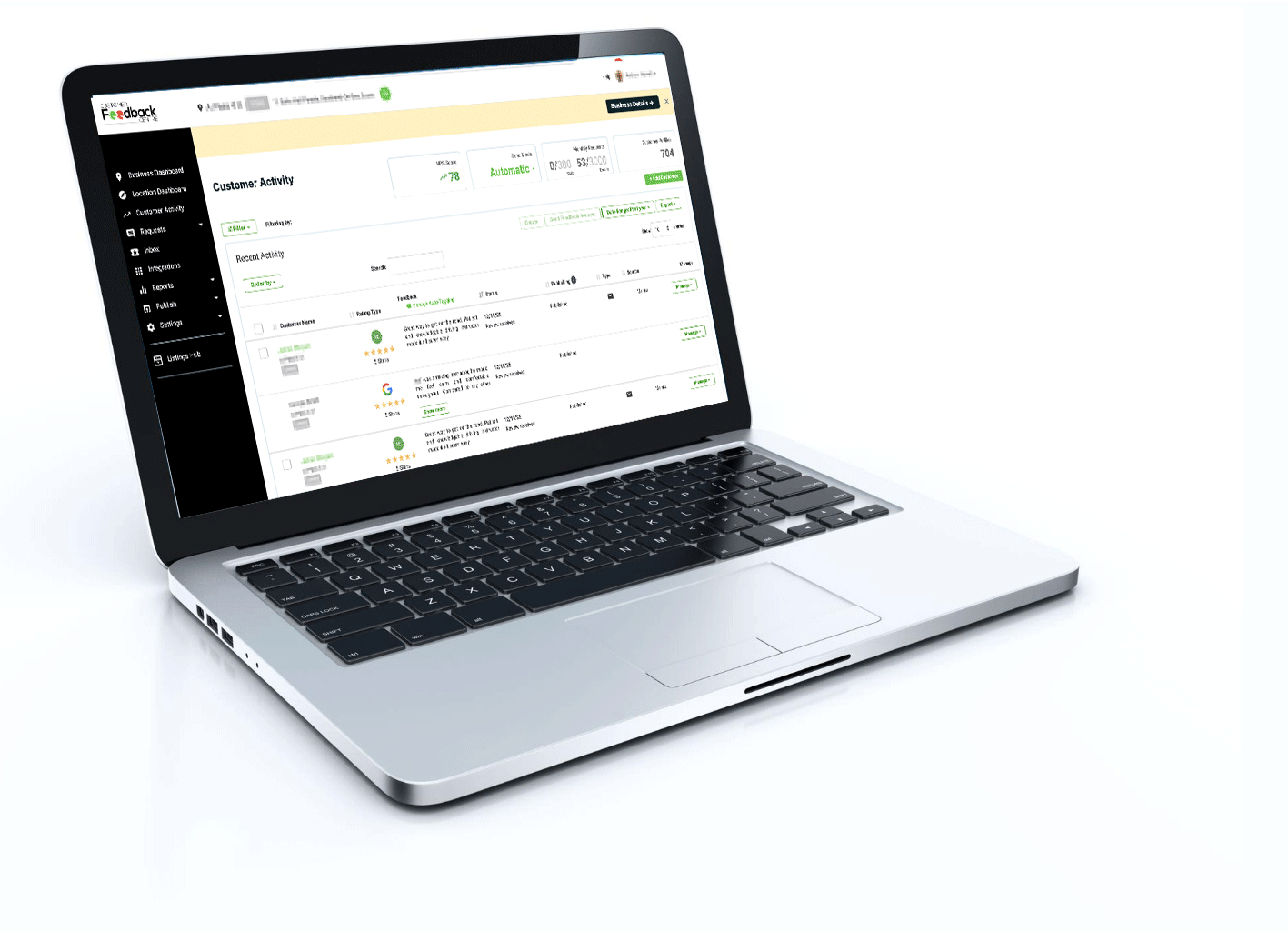
Measuring the Impact of Automated Reviews on Your Reputation Over Time
Automated review collection is not a set-and-forget task. To get the most from it, businesses should track a handful of key metrics and review them regularly.
Review volume growth is the most straightforward measure. Are you collecting more reviews each month than you were three months ago? A steady upward trend confirms the system is working.
A plateau might indicate a drop in response rates that needs investigating.
Average star rating trends tell you something different. A rising average suggests the combination of automation and genuine service quality is working in your favour.
A falling average, on the other hand, is valuable data in itself.
It indicates a service issue that deserves attention, and catching it early through review data is far better than finding out when enquiry levels start to drop.
Response rates, the percentage of customers who receive a request and actually leave a review, give you a direct measure of how effective your requests are.
Industry benchmarks vary, but a well-optimised automated process should consistently achieve response rates in the range of 10 to 20 per cent or higher. If yours is lower, the timing or messaging may need adjusting.
The final measure is the one that matters most for business owners: the impact on enquiry levels.
This is harder to attribute directly, but businesses that track leads alongside review growth often find a clear correlation.
More recent reviews, a higher average rating, and improved local search rankings all feed into the same outcome: more potential customers choosing your business over a competitor's.
Frequently Asked Questions
What is automated review collection and how does it work for UK service businesses?
Automated review collection is the use of software to send review requests to customers automatically after a service interaction, without the business needing to do it manually each time. The system is triggered by a completed job or appointment, and sends a personalised message by email or SMS with a direct link to the business's review page. For UK service businesses, it means every customer receives a request at the right moment, making review collection consistent and scalable.
Is it against Google's guidelines to use automated tools to collect reviews?
No. Google's guidelines permit businesses to ask customers for reviews, including through automated systems. What is not permitted is incentivising reviews, paying for them, or manipulating who receives requests to skew the results. As long as the automated process sends genuine requests to real customers without offering rewards or filtering by expected sentiment, it is fully compliant with Google's policies.
How long does it take to see results from an automated review collection system?
Most businesses start to see a meaningful increase in review volume within the first four to eight weeks. The speed depends on the volume of customer interactions, the response rate to requests, and how active the business's Google listing was before starting. Improvements in local search ranking typically follow as review volume and recency signals build up over two to three months.
Can automated review requests be personalised so they do not feel generic?
Yes. Good automated review collection systems allow businesses to personalise requests with the customer's name, the specific service that was completed, and a message that reflects the business's tone of voice. A well-written automated request can feel just as personal as a manual one, often more so, because it is crafted carefully in advance rather than dashed off in a hurry.
What types of UK service businesses benefit most from automated review collection?
Any UK service business that relies on local customers and online visibility stands to benefit. This includes tradespeople such as plumbers, electricians, and builders, as well as professional services like solicitors, accountants, and financial advisers. Healthcare providers, cleaning companies, estate agents, and home improvement businesses are also strong fits. The common thread is that these businesses win customers through trust, and reviews are one of the most effective ways to build it.
How does automating review collection compare to paying for sponsored reviews or incentivised feedback?
They are fundamentally different approaches with very different outcomes. Automated review collection gathers genuine feedback from real customers without any form of payment or incentive. Sponsored or incentivised reviews involve offering something in return for a positive review, which violates Google's policies and risks having those reviews removed or your listing penalised. Authentic reviews collected ethically also carry far more credibility with potential customers than profiles that appear artificially inflated.
Will customers find automated review requests intrusive or annoying?
Not if the requests are well-timed, brief, and genuinely relevant to the customer's experience. Most customers understand that businesses rely on feedback and are happy to help if the request arrives at the right moment and does not require much effort. The key is to keep the message short, make the link easy to access, and send the request once rather than repeatedly. Businesses that do this consistently find that customers respond positively.
Customer Feedback Centre helps UK service businesses collect genuine customer feedback through automated, ethical review management.
If you want to build a stronger online reputation and attract more customers through consistent, credible reviews, our platform is designed to make that straightforward.
Discover what the Customer Feedback Centre could do for your business.
No contract required. Cancel anytime. Setup in as little as 24 hours.
Prefer to ask a question first? Use the contact form on our Contact page and we'll get back to you promptly.
Recent Posts